 Easy4Pro: industry insight
Navigating the dual-chemistry era
How the rise of sodium-ion batteries will reshape industrial supply chains, freight logistics, and manufacturing agility.
Easy4Pro: industry insight
How the rise of sodium-ion batteries will reshape industrial supply chains, freight logistics, and manufacturing agility.
For over two decades, lithium-ion chemistry has held an effective monopoly on mobile energy storage. But extreme price volatility, severe geographical supply chokepoints, and ethical concerns surrounding cobalt and nickel extraction have exposed structural vulnerabilities in the global battery value chain. Three countries control upwards of 86% of the world's refined lithium, cobalt, and rare earth elements: a concentration that introduces three systemic risks for industrial manufacturers and their logistics teams.
Manufacturers currently trade off supply chain security for energy density. Lithium delivers high range, but its logistics footprint is fragile, expensive, and heavily restricted by dangerous goods regulation.
Sodium-ion (Na-ion) technology doesn't need to unseat lithium to matter. Sodium is thousands of times more abundant, drawn from widely available soda ash or salt deposits, and needs zero cobalt, nickel, or rare earths. Because it also carries a lower energy density than premium lithium chemistries, the market outcome isn't a total swap: it's a functional bifurcation, with each chemistry serving the applications it's actually suited for.
| Dimension | Lithium-ion (NMC / LFP) | Sodium-ion (Na-ion) |
|---|---|---|
| Primary materials | Lithium, cobalt, nickel, graphite, copper | Sodium (soda ash), hard carbon, aluminium |
| Supply abundance | Geographically concentrated / rare | Ubiquitous global availability |
| Transport risk | Class 9 hazmat (thermal runaway risk) | Zero-volt shipping: non-reactive at 0V |
| Cold weather performance | Significant capacity drop sub-zero | Superior thermal stability (-40°C to 60°C) |
| Target applications | Long-range EVs, aerospace, premium devices | Stationary grid storage, city EVs, data centers |
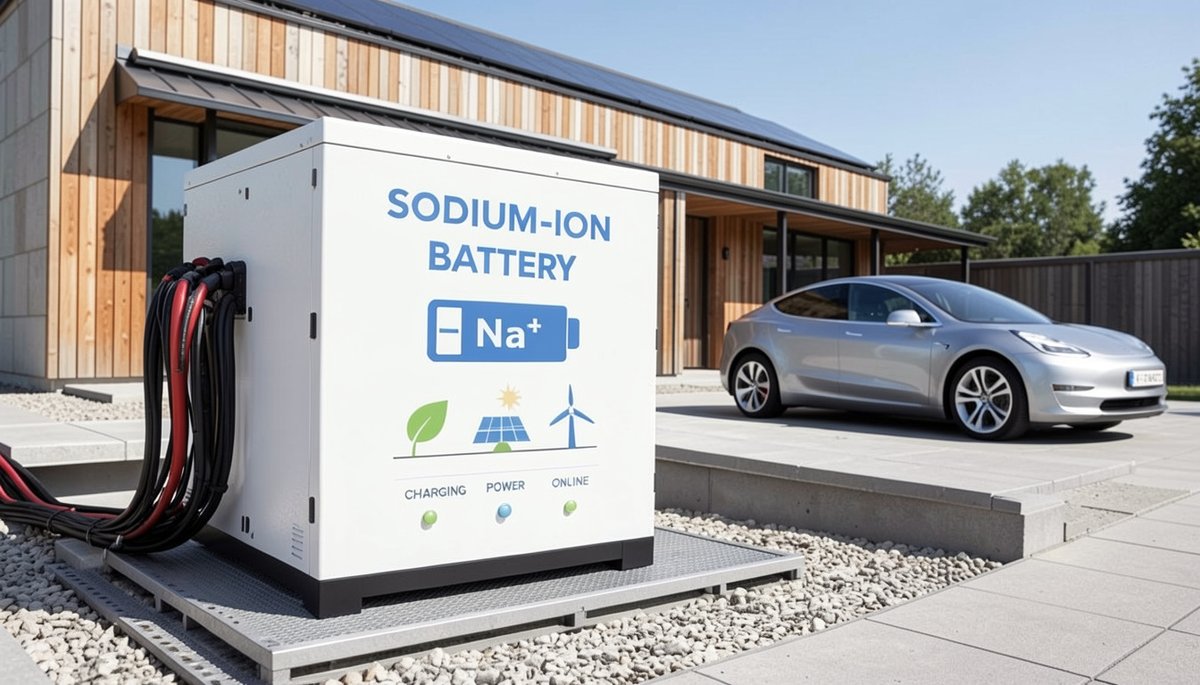
Sodium-ion won't replace lithium in the vehicles that need it most. It replaces the logistics headache in every application that doesn't.
The shift toward dual-chemistry production introduces real, immediate operational changes across industrial transport and factory replenishment, not just a future compliance story.
Sodium-ion cells can be fully discharged to 0V for transport without damaging cell chemistry. At zero volts, they carry no fire risk and bypass UN Class 9 mandates: opening standard dry-van and non-specialised carrier capacity that lithium shipments can't touch.
Lower energy density means a sodium pack of equivalent power is roughly 20–30% heavier than its lithium counterpart. Trucks will "weigh out" on gross vehicle weight before they "cube out" on volume: pushing freight planning toward per-ton rate structures and axle load discipline.
OEMs running hybrid assembly lines (entry-level sodium models alongside premium lithium variants) take on more inventory complexity, with sudden part substitutions and urgent spot-freight spikes whenever raw material flows hit a localised delay.
Thriving in a dual-chemistry supply chain takes a transport execution platform built for multi-carrier orchestration and real-time spot procurement, not a single default carrier relationship. That's the operational layer Easy4Pro provides.
Shipments get routed by chemistry and discharge status: lithium through certified hazmat lanes, 0V sodium opened up to Easy4Pro's broader standard road freight network, reducing freight spend and securing capacity faster.
Higher inventory jitter on hybrid lines means unexpected component delays. Easy4Pro's spot tendering lets plant managers launch competitive requests across a large carrier base within seconds, instead of waiting on a single relationship.
Heavier sodium shipments raise the odds of overweight surcharges. Full invoice pre-auditing and carrier competition are how Easy4Pro customers see an average of 28% cost avoidance on freight spend platform-wide.
Generic API integration (with SAP and other ERPs supported at no extra cost) connects chemical suppliers, cell manufacturers, and plants under a single view of transport, instead of three disconnected systems.
Sodium-ion will untether parts of the industry from mineral monopolies and lower the cost of stationary and city-EV energy storage. But the manufacturers who win this transition won't be the ones who simply adopt the new chemistry; they'll be the ones who adapt their logistics infrastructure to handle dual-chemistry complexity with speed and precision.
That means treating freight execution as part of the battery strategy, not an afterthought to it: carrier pools that expand automatically with discharge status, spot capacity that's one tender away, and full visibility into what a heavier pack actually costs to move.