PPWR Explained: What the EU Packaging Waste Regulation Means for Freight and Logistics
Today, the EU's Packaging and Packaging Waste Regulation begins applying across all Member States, replacing a fragmented national system with one EU-wide rulebook on packaging waste, recyclability, and food-contact safety.
Packaging & Packaging Waste RegulationEU-wide, no transpositionLast updated Aug 12, 2026
What Is PPWR and Why It Applies From August 12, 2026
Today, August 12, 2026, the EU's Packaging and Packaging Waste Regulation (PPWR) begins applying across all Member States. The Council of the European Union formally adopted it on 16 December 2024. Application follows about 18 months after entry into force.
The European Commission states the goal plainly: reduce packaging waste, increase recycling, and make food-contact packaging safer by restricting harmful substances such as PFAS, according to Commissioner Jessika Roswall. The PPWR regulation replaces the 1994 Packaging and Packaging Waste Directive. Unlike that directive, it applies uniformly across the EU, with no national transposition needed.
The Rationale
Why the EU Introduced the PPWR Regulation
The Commission's own projections make the case for urgency. Without intervention, EU packaging waste was expected to grow by 19% by 2030. Plastic packaging waste alone could rise by up to 46%, according to the European Commission.
Reuters reports that packaging waste has already increased by more than 20% over the past decade. Europeans generate roughly 180 kg of packaging waste per person each year. Only 42% of that waste was actually recycled in 2023, even though packaging makes up around 40% of all plastic consumed in Europe.
The Council cites a separate 2022 baseline: 186.5 kg of packaging waste per person, of which 36 kg was plastic. The Commission puts current EU plastic packaging waste at around 35.3 kg per person.
The goal: cut those volumes, reduce reliance on virgin raw materials, and put the packaging sector on a path toward full recyclability and climate neutrality by 2050.
European Commission, packaging waste topic page
Effective Today
What PPWR Changes From August 12, 2026
The Commission lists three PPWR compliance obligations as immediate, effective today:
01Substance restrictions. Per- and polyfluoroalkyl substances (PFAS) are now restricted in food-contact packaging above strict limits. Reuters notes the health rationale behind this: PFAS accumulation has been linked in research to cancer, kidney disease, immune disorders, pregnancy complications, and developmental issues in infants.
02Producer and EPR definitions. Harmonised EU-wide definitions for manufacturers and for extended producer responsibility (EPR) now apply, replacing the patchwork of national interpretations that existed under the old directive.
03Identification and markings. Packaging manufacturers and importers must now provide required markings and identification information.
The regulation also restricts several single-use plastic items outright. These include pre-packed produce under 1.5 kg, beverage and food containers used in hospitality, individual condiment portions and cosmetic or toiletry samples in accommodation, and lightweight plastic bags. Take-away businesses must now let customers use their own containers for food and drinks at no extra charge.
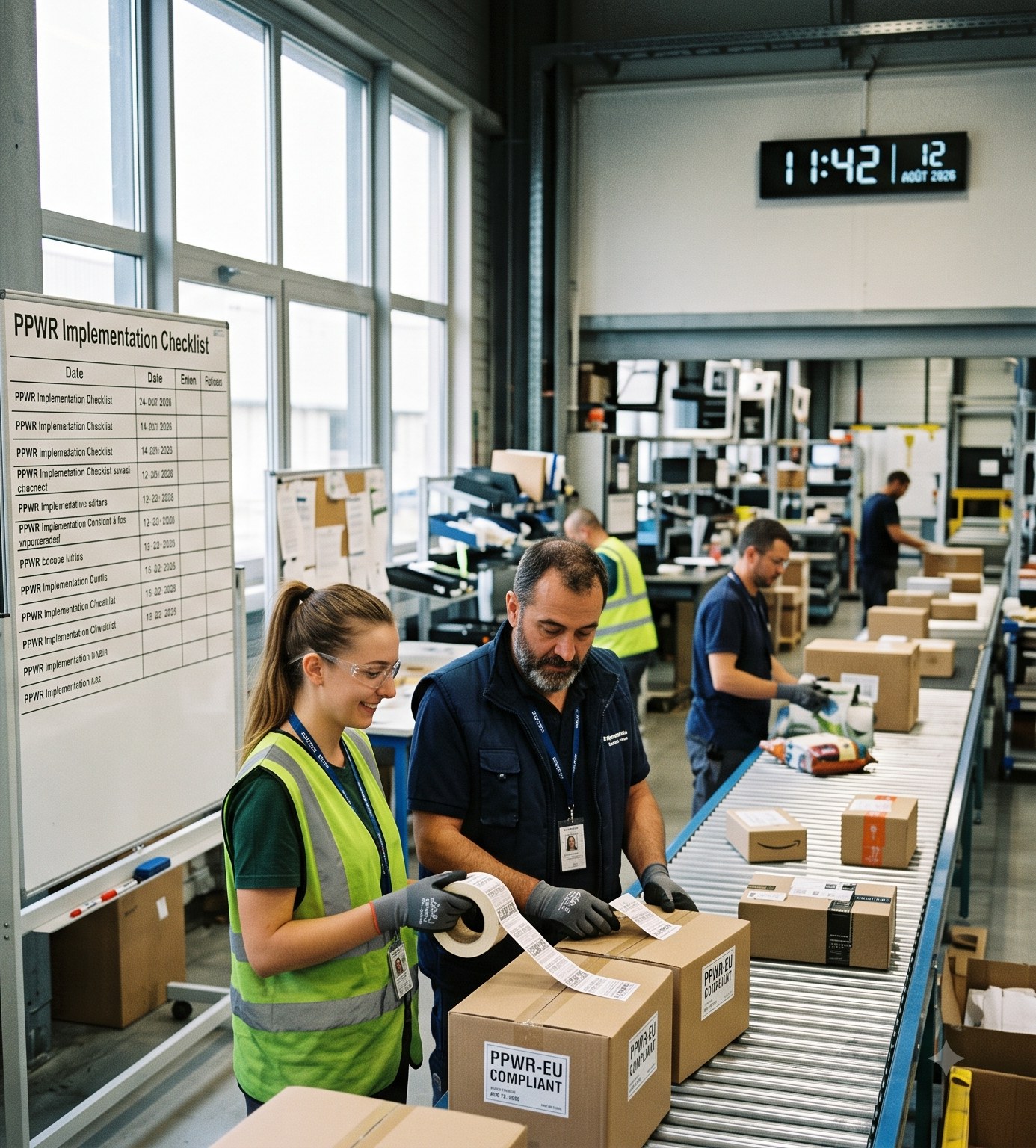
Packaging leaving the line today carries PPWR-EU compliance labelling as a matter of course, not a special case.
The Roadmap
PPWR Compliance Requirements Through 2030 and 2040
Today's obligations are only the starting point. Several tighter requirements converge over the next decade and a half.
By 2028
EU-wide labelling
A harmonised EU-wide labelling system for packaging is due, meant to make waste sorting more consistent across Member States.
From 2030
Reuse & recyclability
Packaging must stay within limits on empty space, meet binding reuse targets, and be recyclable. New plastic packaging must include recycled content, and very small single-use plastic formats in hospitality face restrictions. The Council's targets: a binding 40% reuse target for transport and sales packaging, and a binding 10% reuse target for grouped packaging.
By 2040
Recycled-content ceiling
Recycled-content requirements build toward up to 65% in single-use plastic bottles. Reuters independently confirms the waste-reduction targets behind these measures: a 5% per-capita cut by 2030 and 15% by 2040, both against a 2018 baseline.
Industry Pushback
What Businesses Are Telling Brussels
Euronews reported in March 2026 that industry was still pushing EU institutions for implementation clarity, just months before today's deadline. The soft drinks sector's trade body, UNESDA, flagged three specific gaps:
01A harmonised EU-level methodology for the PFAS restriction. Without it, Member States could apply the rule differently and fragment the single market.
02Guidance on plastic grouped packaging. This wasn't expected until 2027, even though the compliance deadline is 2030, and the sector estimates transition costs above €2 billion for soft drinks companies alone.
03Clearer rules on national exemptions for reuse requirements, since some Member States have already built substantial collection and recycling systems.
Businesses "cannot afford halting operations" and need "legal clarity and certainty" to stay competitive.
Nicholas Hodac, Director General, UNESDA
Progress already made
The same reporting noted real progress. Some companies have reached or nearly reached 100% recyclability. Sixteen EU countries already run deposit-return schemes. And 51.7% of PET used in plastic bottles came from recycled content in 2024, ahead of both the 2025 and 2030 EU targets.
Why It Matters For Freight
Why PPWR Matters for Freight and Logistics Operations
Freight forwarders, shippers, and the platforms that coordinate them, including freight procurement platforms like Easy4Pro, sit downstream of the packaging decisions PPWR now governs. Even so, they aren't insulated from its consequences. Packaging that fails to meet the substance restrictions or identification requirements now in force cannot legally be placed on the EU market. Shipments built around non-compliant packaging carry a direct risk of disruption, regardless of which party made the original packaging choice.
Reuse and recycled-content data increasingly travels with the shipment itself, not just the packaging spec sheet.
The reuse and recycled-content targets arriving through 2030 and 2040 will turn packaging into a data point that needs to travel with the shipment itself: what it's made of, how much is recycled, and whether it meets the reuse target for its category.
The industry pushback reported by Euronews is a useful signal in its own right. Even sectors with strong compliance track records are asking for more implementation guidance, on points like PFAS methodology, grouped packaging, and reuse exemptions. That suggests some of the operational detail is still being worked out at EU level, even as today's deadline arrives.
The Bottom Line
The Bottom Line on PPWR Compliance
The Commission and Council have been consistent on this point: PPWR applies from today, replacing a fragmented national system with one EU-wide rulebook. Recycled-content and reuse thresholds will keep tightening through 2030 and 2040.
At the same time, reporting from the ground shows real industry uncertainty about how some of these rules will apply in practice. Businesses in the freight chain don't set packaging specifications directly. But they will increasingly need visibility into packaging compliance data, so they don't absorb the operational risk of someone else's non-compliant packaging.
 EU Regulation · Effective August 12, 2026