CBAM Scope Expansion: 457 Products, One September Vote
On September 15, 2026, the European Parliament voted 464 to 50 to push CBAM's reach far beyond raw steel and aluminum, into finished parts like fasteners, wire and springs.
EU Carbon Border MechanismParliament vote: Sept 15, 20267 min read
Some context first. CBAM's definitive phase began on January 1, 2026, requiring importers of raw steel, aluminum, cement, fertilizers, hydrogen and electricity above a 50-tonne annual threshold to register, monitor emissions and prepare for certificate purchases starting February 2027. That baseline hasn't changed. What changed this month is how far beyond those raw materials the mechanism is about to reach.
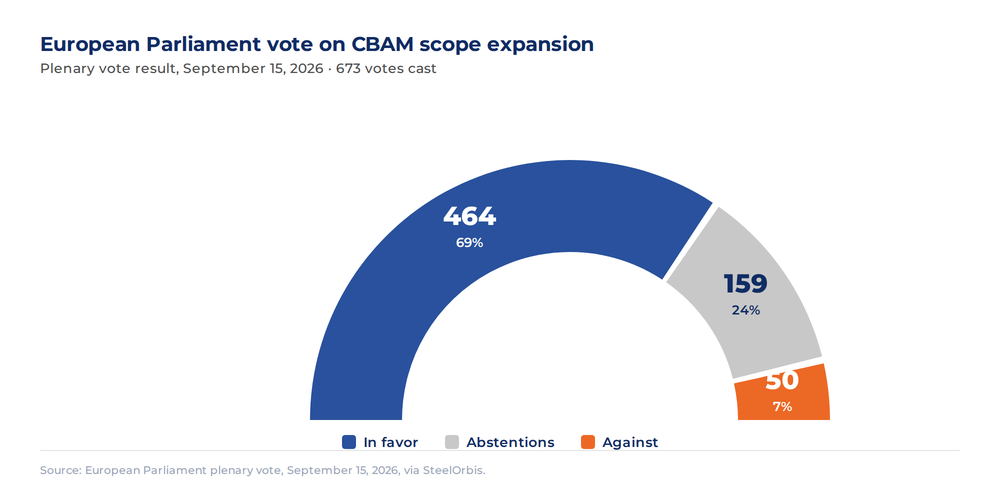
The vote itself was not close. Parliament adopted its negotiating position with 464 votes in favor, 50 against and 159 abstentions, confirming a text its environment committee had already cleared in June, SteelOrbis reported.
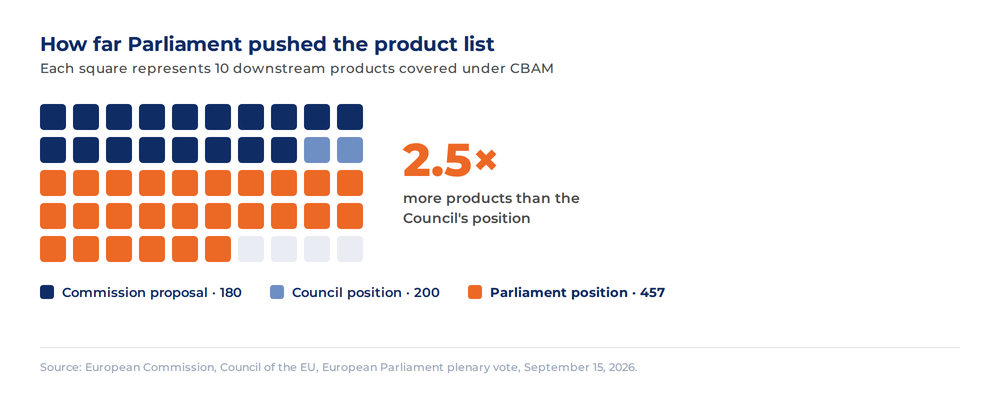
What makes this a genuine CBAM scope expansion, not a technical tweak, is the size of the product list. The European Commission's original proposal covered around 180 downstream products. The Council of the EU had settled on roughly 200. Parliament's adopted position pushes that to approximately 457 product lines, according to VATupdate, more than double the Council's figure.
The position also tightens anti-circumvention rules, lowering the threshold at which a minor product modification counts as an attempt to dodge CBAM and giving the Commission more room to apply default emissions values where reporting looks unreliable. It moves the EU's Temporary Decarbonisation Fund for exposed producers forward to 2027 instead of 2028, and extends its eligibility to fertiliser producers and downstream users along the way.
None of this is law yet. Parliament's position is a mandate for trilogue negotiations with the Council and Commission, and the current, narrower CBAM scope stays in force until an amending regulation is actually adopted. But a 464 to 50 result is a strong signal of where that negotiation is heading, and how little appetite there is in Parliament to leave downstream products out of it. It's not the first EU compliance deadline to build up in stages rather than land all at once, and the lesson for procurement is the same one that applies here: get the exposure mapped before the deadline forces the question.
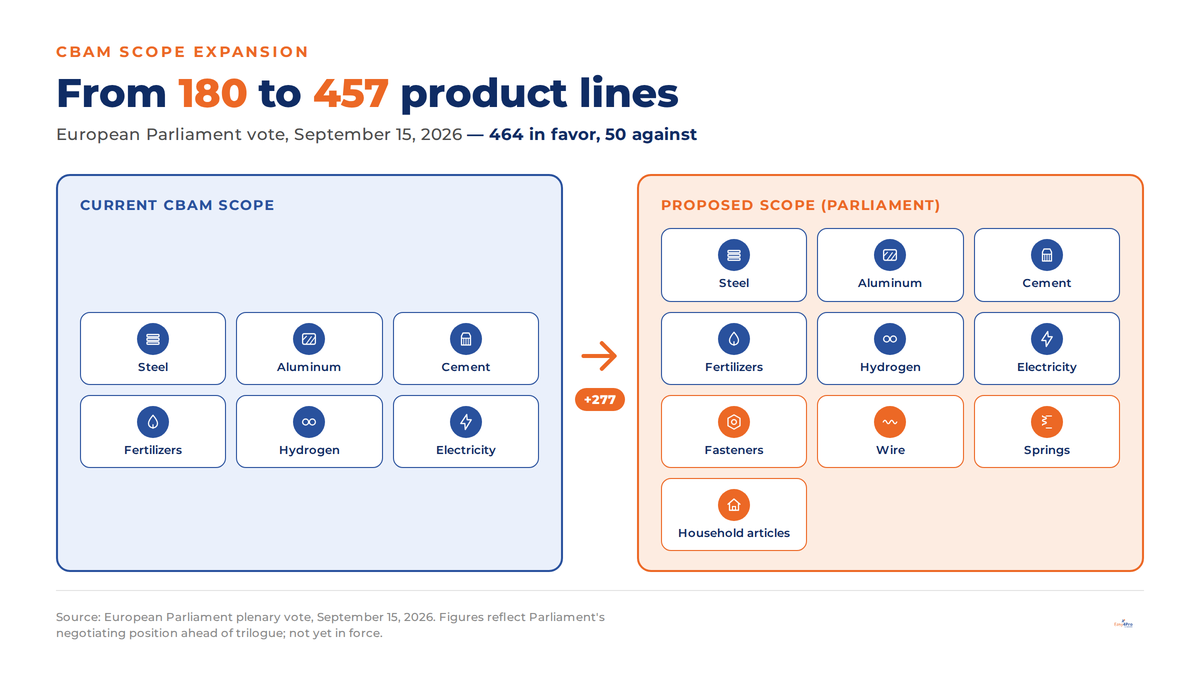
CBAM's proposed scope, before and after Parliament's September 15 vote.
The Scope
Why This Reaches Deeper Than Steel and Aluminum
The product list is the part procurement teams should read closely. Alongside household articles, it names fasteners, wire and springs by name, the kind of components that sit inside automotive assemblies rather than a steel mill's shipping manifest. As one compliance briefing put it, automotive supply chains that assumed component imports sat outside CBAM "should re-test that assumption while the scope is still being negotiated in trilogue."
That matters because tier-1 and tier-n automotive suppliers are exactly who imports finished metal parts on this scale. A bracket, a spring or a set of fasteners sourced from outside the EU has, until now, sat comfortably outside CBAM's raw-materials scope. Under Parliament's position, the same part could carry its own embedded-carbon calculation the moment it crosses the border, on top of whatever the supplier already charges for it.
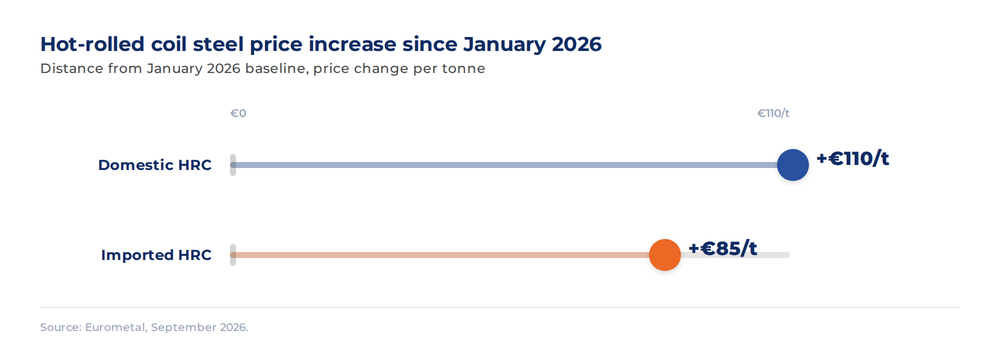
That expansion is landing on top of costs that are already visible. Domestic hot-rolled coil steel prices have risen €110 per tonne since January 2026, and imported HRC is up €85 per tonne over the same period, Eurometal reported, a move the industry links directly to CBAM's definitive phase taking effect.
The Cost Impact
Landed Cost Now Has a Carbon Line
Landed cost used to mean product price plus freight plus customs duty. CBAM adds a fourth number, one that changes by supplier, by country of origin and increasingly, if this expansion holds, by how many finished parts a shipment contains rather than just its raw material content.
The carbon price underneath those numbers is still climbing too: the benchmark EU ETS allowance settled at €86.89 on September 21, its fifth straight weekly gain and just below a nine-month high, driven largely by compliance buying, Emba Power reported. CBAM certificate prices are set quarterly as an average of EU ETS auction prices, so a rising ETS market now points toward a higher certificate benchmark later this year, on top of whatever new products end up in scope.
That makes this a procurement decision, not just a compliance one. Choosing a fastener or spring supplier on price alone, without knowing whether that line will fall inside an expanded CBAM scope, means choosing blind on total landed cost. A shipment routed through a longer or less efficient lane doesn't change the certificate cost, but it does compound the total bill sitting on top of it.
This is exactly what platforms like Easy4Pro are built for: giving procurement teams one place to see contract, pre-negotiated and spot freight costs together, so a moving cost variable like CBAM's scope doesn't have to be reconciled from five different spreadsheets before anyone can act on it.
Industry Reaction
Industry Says It's Still Not Enough
The steel industry's reaction was not celebration. Alexander M. Julius, Eurometal's president, called the outcome progress but said the proposed scope remains incomplete and implementation is too slow, pointing to the absence of any solution for EU exporters who carry carbon costs at home while competing against producers who don't, per Eurometal.
“The proposed scope remains incomplete, implementation is too slow.”
Alexander M. Julius, President, Eurometal
The broader complaint is that CBAM alone doesn't offset the price and regulatory gap facing European manufacturers. Industry groups are pushing for coverage across the full range of steel and aluminum-intensive products, faster implementation, and support for domestic producers to keep production from simply relocating outside the EU rather than decarbonizing in place. Notably absent from the current text, they point out, is any mechanism protecting EU exporters who carry CBAM-equivalent carbon costs at home while competing against producers who don't face anything similar abroad.
For procurement teams, the message is the same one that mattered before the vote: this is not a settled rulebook. A product list, a default value or an exemption threshold that looks fixed in September can move again before trilogue concludes, and the direction of travel so far has consistently been toward broader coverage, not narrower.
Next Steps
What to Do While the Trilogue Plays Out
01Re-test scope assumptions. Don't trust last year's scope list. If a sourcing category includes fasteners, springs, wire or other finished steel and aluminum parts, don't assume it sits outside CBAM just because it did in the transitional period. Map which SKUs and suppliers would fall into scope under Parliament's 457-product position, even before that position becomes law, so the exercise isn't rushed once trilogue actually concludes.
02Track the certificate price trend. Don't wait for a single announcement. With the EU ETS market at a nine-month high and CBAM certificates priced quarterly off that same auction average, a supplier or lane that looked affordable in Q1 2026 may not stay that way through the rest of the year. The stricter anti-circumvention rules in Parliament's text are worth a second look too: a supplier relationship built around minor product modifications to stay technically out of scope is exactly what the Commission is now empowered to unwind with default emissions values.
03Put freight, customs and certificate cost side by side. Stop leaving them buried in separate systems. A Tier 1 automotive supplier operating across 50 plants used exactly this kind of consolidated visibility to cut its overall freight spend by 28%, proof that treating cost variables together, rather than in isolation, is where the savings actually show up.
Conclusion
Final Thoughts
CBAM's scope is no longer just a raw-materials question. A 464 to 50 vote in September moved the debate toward finished parts, automotive components among them, and the steel industry's own response makes clear this negotiation is far from over. The importers who come out ahead won't be the ones who memorize this month's product list. They'll be the ones who build sourcing and freight decisions around a mechanism that keeps moving, months before trilogue delivers a final answer.
See your full landed cost, freight included, in one place with Easy4Pro: zero implementation cost, no volume commitment for your first two months.
 Regulation & Compliance