Both run on the same infrastructure your freight uses: the same suppliers, the same rail lines, the same roads and ports. If you manage logistics or supply chain for a European manufacturer, here is what each one is, and what it changes for you.
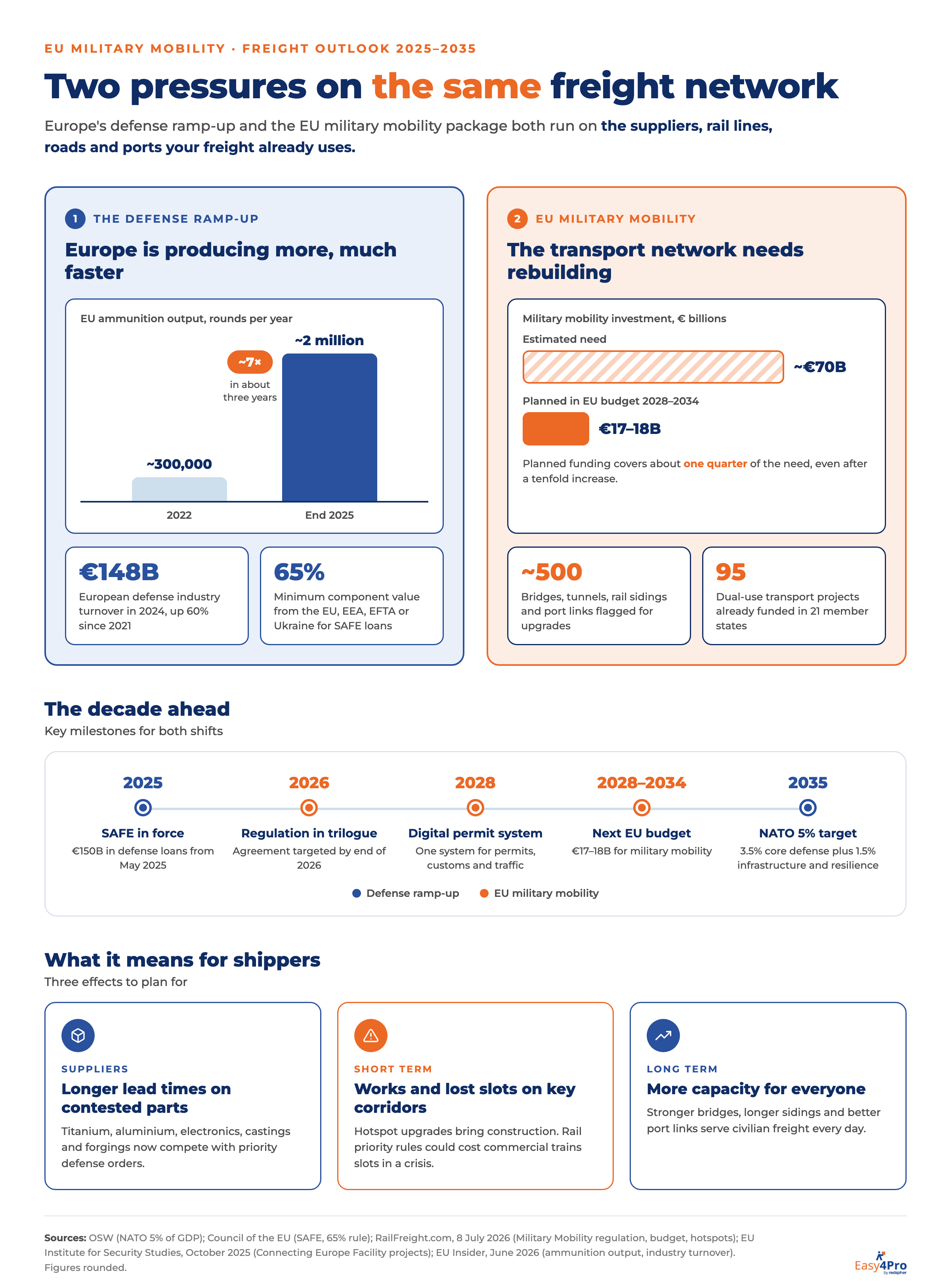
Three commitments set the pace for the next decade.
| Commitment | Figure | Timeline |
|---|---|---|
| NATO spending target | 5% of GDP: 3.5% core, 1.5% for infrastructure, resilience and industrial base | By 2035 |
| EU SAFE loan instrument | €150 billion in loans | In force since May 2025; 18 national plans approved Feb to Apr 2026 |
| EU military mobility budget | About €17 to 18 billion, a tenfold increase | Next EU budget, 2028 to 2034 |
Production is already responding. EU ammunition output grew from about 300,000 rounds a year in 2022 to roughly 2 million by the end of 2025, according to EU Insider. European defense industry turnover reached €148 billion in 2024, up 60% since 2021.
SAFE loans also carry a sourcing rule: at least 65% of component value must come from the EU, the EEA, EFTA countries or Ukraine, per the Council of the EU. That keeps most of the new production, and the freight it creates, inside Europe.
The limit on the ramp-up is no longer funding. It is factory capacity, and that capacity is shared with civilian industry.
Defense contractors buy the same titanium, aluminium alloys, semiconductors, castings and forgings as automotive and machinery manufacturers. Their orders come with priority and long contracts, so shared suppliers move capacity toward them. They also hire from the same pool of CNC operators and engineers.
A new defense production line takes 4 to 5 years to certify, so demand will stay ahead of supply for years, not quarters.
For a non-defense manufacturer, that means longer lead times on contested parts and more competition for the same European suppliers. When lead times stretch, visibility and planning matter more. Aerospace shows what happens when they fall short: commercial aerospace inventory has piled up while turnover slowed to a ten-year low.
The 65% rule adds a freight dimension. Expect more short, frequent road and rail flows between European Tier 2 and Tier 3 suppliers, and more competition for the regional carriers that serve them.

Europe's armed forces do not run their own transport network. They move on civilian rail, roads, ports and carriers. The EU military mobility package is the plan to make that network fit for heavy, fast, cross-border transport.
The core is a new Military Mobility regulation. It entered trilogue negotiations in July 2026, with agreement targeted for the end of 2026, as RailFreight.com reports. It has three parts that matter for freight.
| Element | What it does | Status |
|---|---|---|
| Infrastructure hotspots | About 500 bridges, tunnels, rail sidings and port links identified for upgrades; thousands more may follow | Mapping and funding under way |
| Rail priority rules | Defense transport could get priority on rail infrastructure in a crisis | Compensation for private operators still under negotiation |
| Digital permit system | One shared system for transport permits, customs and traffic coordination | Due no later than 2028 |
The funding gap is large. The EU puts the investment need at about €70 billion, roughly four times the €17 to 18 billion planned in the next budget.
In the short term, expect friction. Upgrading 500 hotspots means construction works on bridges, sidings and port access roads, often on busy freight corridors. If rail priority rules pass in their current form, commercial trains could also lose slots at short notice during a crisis.
In the long term, expect more capacity. Stronger bridges, longer sidings and better port links serve civilian freight every day. The Connecting Europe Facility has already funded 95 dual-use transport projects in 21 member states. The 2028 digital permit system may also simplify cross-border paperwork beyond defense.
Which lanes feel it first depends on where the hotspots are. If your key lanes run through major cross-border rail and road corridors, plan for the disruption before you see the benefit. It is the same pattern shippers saw with the EU Mobility Package's impact on freight rates: regulation reshapes capacity first, and prices follow.
You do not need a defense contract to prepare. Five practical steps:
The last point is where many teams struggle. When freight is booked across email and spreadsheets, switching modes or carriers takes days. Shippers using a digital freight platform such as Easy4Pro report logistics operations running 75% faster than with email and spreadsheets. When capacity can disappear at short notice, that speed is the difference between rerouting and waiting.
The defense ramp-up and the military mobility package are two sides of the same ten-year shift. The first competes for your suppliers and materials. The second will disrupt, then expand, the corridors your freight runs on.
The companies that come through it best will be the ones that see the overlap early and keep their freight flexible. That is the thinking behind Easy4Pro: one platform to compare modes, carriers and rates, so teams can adapt when the network changes. Test it on your own lanes: zero implementation cost, no volume commitment for your first two months.