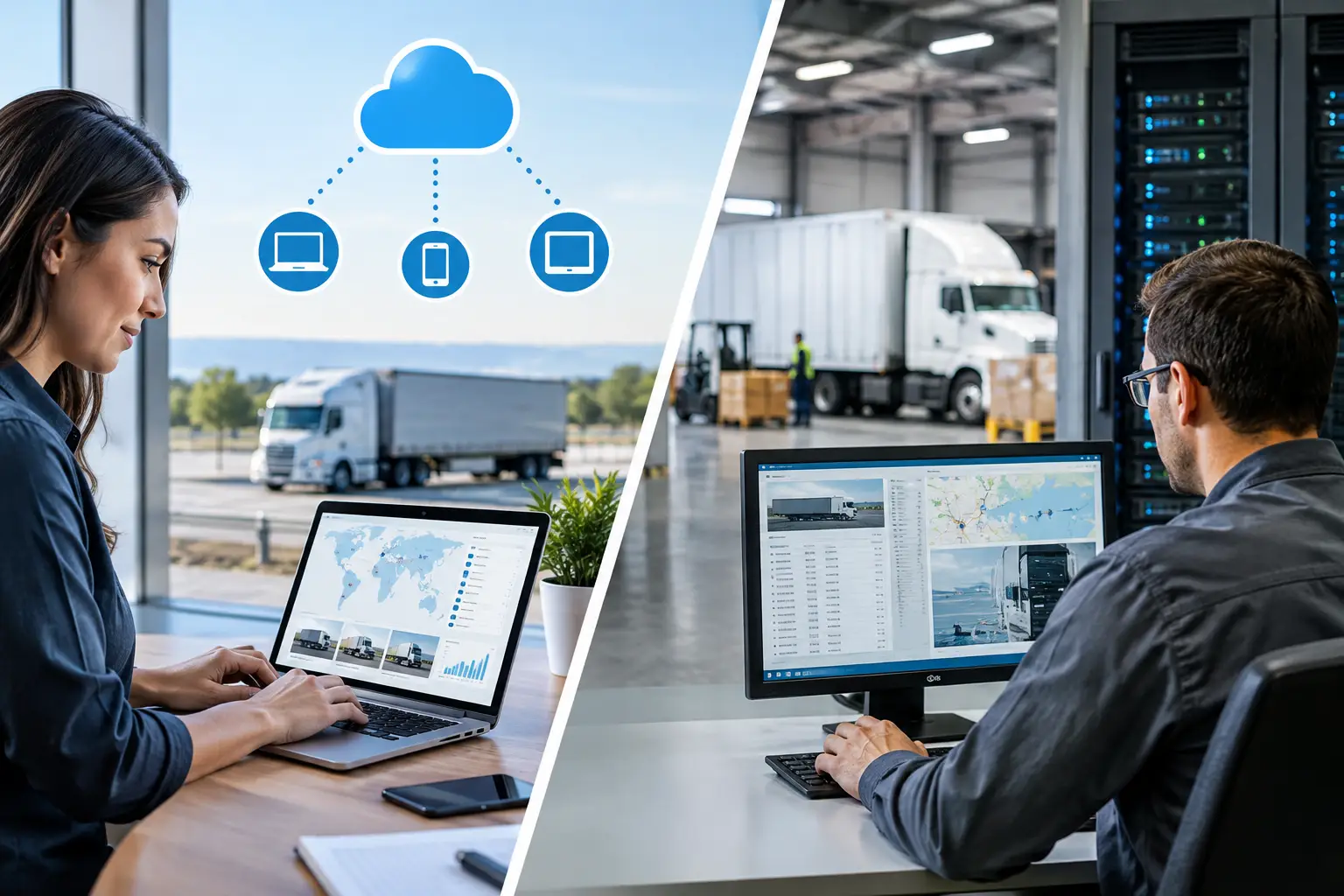
A transportation team should not have to choose between controlling its freight network and responding quickly when conditions change. Yet that is often the real decision behind cloud TMS versus on premise. The deployment model affects how fast new plants, carriers, lanes, workflows, and data sources can be brought into the operating environment - and how much internal effort is required to keep that environment moving.
For shippers managing contracted freight alongside recurring spot requirements and urgent exceptions, this is not simply an IT architecture discussion. It is a procurement, execution, visibility, and finance decision. The right choice depends on the operating model, the level of internal technology capacity, and how frequently the freight network changes.
Cloud TMS Versus On Premise: The Core Difference
An on-premise TMS is installed and operated within a company-controlled IT environment. The shipper typically manages the infrastructure, system upgrades, security configurations, integrations, and release timing, either directly or through internal technology partners. This can offer a high degree of control over the environment and may fit organizations with established infrastructure standards, highly specialized workflows, and teams dedicated to transportation technology support.
A cloud TMS is accessed through a provider-managed platform. The provider operates the underlying environment and delivers updates across the product, while the shipper configures its transportation workflows, users, rules, carrier connections, and reporting within the platform. For many freight teams, the operational advantage is speed: they can focus on sourcing, tendering, tracking, dock coordination, and invoice validation rather than maintaining application infrastructure.
Neither model automatically creates better transportation performance. A carefully managed on-premise deployment can support sophisticated operations. A cloud platform still requires clean master data, clear process ownership, carrier participation, and disciplined adoption. The difference is where the ongoing technology burden sits and how quickly the system can adapt when the freight operation changes.
Implementation Speed Is an Operating Advantage
Transportation plans rarely stay still. A new customer distribution center opens, a supplier network expands, capacity tightens on a key lane, or a plant needs a more structured appointment workflow. Each change introduces data, process, and user requirements.
With an on-premise environment, a change may require internal infrastructure planning, release coordination, testing windows, and specialized development work. That level of governance can be appropriate where changes are infrequent and tightly controlled. It can also lengthen the path from a business need to a working workflow.
Cloud deployments generally reduce the infrastructure work required to get started and to extend the system over time. That does not mean implementation should be rushed. The strongest projects still begin with lane data, carrier agreements, facility requirements, tender rules, access roles, invoice logic, and exception paths. The difference is that the team can direct more energy toward operational design instead of server and release management.
For a transportation director, the practical test is simple: if a new site needs to go live, how many teams must act before a planner can tender a shipment, a carrier can respond, and finance can validate the invoice? The answer reveals more than a feature checklist does.
Cost Is More Than a License Decision
The visible cost of an on-premise TMS can include licensing, implementation services, infrastructure, upgrades, customization, and support. The less visible cost is the internal time required from IT, security, data, operations, and finance teams over the life of the system. That effort is manageable when it is planned, staffed, and justified by the organization’s operating requirements.
Cloud TMS economics often shift spending toward the transportation activity being processed rather than large upfront software commitments. This can align platform cost more closely with freight activity and make it easier to evaluate value as the network changes. Still, buyers should look beyond the commercial model. They should ask what services are included, who owns configuration changes, what data is available, how integrations are maintained, and what happens when new facilities or business units are added.
The most useful comparison is total operational cost, not just software cost. Include the time spent reconciling carrier portals, updating spreadsheets, chasing tender responses, resolving shipment status questions, and matching invoices to freight terms. A platform that reduces those handoffs can produce value even before a transportation team changes its carrier strategy.
Control Depends on Configuration, Not Server Location
Some shippers equate on-premise deployment with control and cloud deployment with compromise. That framing is too simple. Control in transportation comes from enforceable business rules, accurate data, clear user permissions, a reliable audit trail, and visibility into what happened at each step of a shipment.
A cloud TMS should let teams configure how freight is sourced, when a load follows a contract, when it uses a pre-negotiated option, and when an exception requires a live market response. It should also provide controlled tender workflows, carrier scorecard data, facility-level visibility, and invoice validation against agreed terms. Those capabilities create operational control because decisions are standardized and measurable.
On-premise can be the right fit when a shipper requires deep, unique customization that cannot reasonably be handled through platform configuration, or when internal policies require the company to operate the complete application environment. Even then, the team should distinguish between customization that drives a genuine advantage and customization that preserves an outdated process.
The question is not, “Where does the software sit?” It is, “Can our teams make the right transportation decision quickly, document it, and measure the result?”
Integration Determines Whether the TMS Becomes the System of Work
A TMS produces limited value if planners must leave it to gather order data, request pricing, check shipment status, manage appointments, or investigate invoices. This is where many deployment decisions become operationally significant.
The platform needs a practical connection to the systems and parties that shape freight execution. Depending on the network, that may include ERP and order systems, warehouse processes, carrier communications, visibility data, dock schedules, financial workflows, and business intelligence tools. Open APIs and structured data exchange matter because they reduce duplicate entry and make transportation data usable across the business.
Cloud platforms are often well suited to iterative integration because connections can be configured, tested, and extended as the network develops. But the provider’s integration approach should be examined closely. Ask how exceptions are handled, how data ownership works, how often information refreshes, and whether transportation and financial data remain connected from tender through payment.
For organizations managing both planned moves and urgent shipments, one workflow matters especially: the ability to evaluate contracted, pre-negotiated, and live-bid options without moving work into separate tools. Fragmentation creates slower decisions and makes it harder to explain why a particular freight choice was made.
Security and Reliability Require Shared Accountability
Security should be evaluated with the same discipline as procurement or carrier performance. With on-premise software, the shipper owns more of the underlying responsibility for infrastructure protection, patching, access controls, monitoring, backups, and recovery procedures. This may suit organizations with mature internal capabilities and policies built for that responsibility.
With cloud software, the provider is responsible for operating and protecting the platform environment, while the shipper remains responsible for user access, data governance, internal controls, and appropriate use of the system. Buyers should review access controls, auditability, availability practices, incident processes, data handling, and the division of responsibilities. A cloud deployment does not remove accountability. It makes accountability shared and requires it to be explicit.
Reliability also has an operational dimension. Transportation teams need a dependable record of tenders, carrier responses, milestones, documents, charges, and exceptions. A system that keeps this information in one operating environment gives operations and finance a common version of the shipment.
Choose Based on Change Velocity
Cloud is generally the stronger fit when a freight network is expanding, when carrier and capacity options need to be evaluated dynamically, or when the business wants to unify procurement, execution, visibility, and payment workflows without creating a heavy internal technology burden. It is also well suited to teams that need to activate facilities and users quickly while maintaining standardized controls.
On-premise may be justified when the organization has a firm internal deployment mandate, unusually specialized requirements, and the resources to operate, enhance, and secure the application over time. Those conditions are real, but they should be tested against the cost of slower adaptation and separate tools around the TMS.
A practical evaluation should use real shipment scenarios, not generic demos. Test a contracted lane, a capacity exception, a late pickup, a dock conflict, a carrier status request, and an invoice discrepancy. Then measure how many handoffs occur, how quickly the team gets an answer, and whether the system preserves a usable record from sourcing through payment.
Easy4Pro is built for that connected freight workflow: giving transportation teams a single operating environment to source, execute, track, validate, and pay for freight while retaining the flexibility to route each shipment through the right available option.
The best deployment decision is the one that lets your team absorb the next network change without adding another spreadsheet, inbox, or disconnected process.