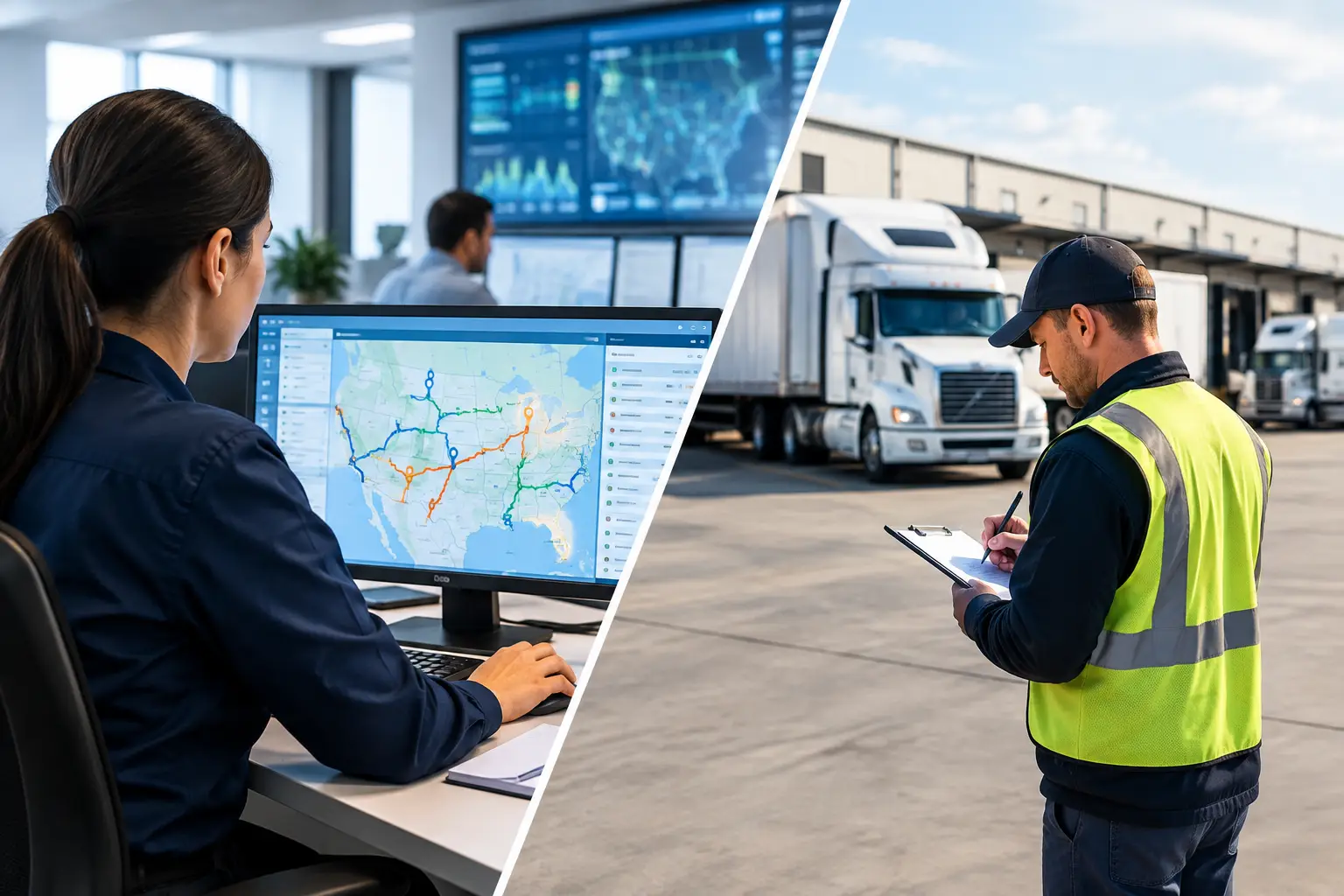
A plant needs a pickup moved forward after production finishes early. A contracted carrier has no truck available. Dock capacity has changed, customer delivery windows remain fixed, and the transportation team is already managing a full tender queue. This is where dynamic routing versus manual dispatch stops being a technology discussion and becomes a margin, service, and control decision.
Manual dispatch can work well in stable, low-volume networks where experienced planners know every carrier, lane, and exception by memory. But as locations, carriers, shipment types, and service commitments multiply, that approach puts too much of the network inside inboxes, spreadsheets, phone calls, and individual judgment. Dynamic routing gives teams a structured way to evaluate available procurement options and execute the best fit while keeping people in control of the rules.
What separates dynamic routing from manual dispatch?
Manual dispatch is a planner-led process. A transportation coordinator reviews shipment requirements, checks a rate card or spreadsheet, contacts one or more carriers, confirms capacity, updates the shipment record, and follows up through delivery and invoicing. The process can be highly effective when the planner has strong carrier relationships and the shipment is straightforward.
Its constraint is speed and repeatability. Every new exception can require another round of searching, emailing, calling, comparing, documenting, and escalating. If shipment data lives in separate systems, the planner may also need to reconcile order details, appointments, carrier status, accessorials, and invoices across multiple screens.
Dynamic routing uses configured business rules and live operational data to determine how a shipment should be sourced and tendered. It can first evaluate contracted capacity, then pre-negotiated spot options, then a live-bid process when market conditions or urgency demand it. The routing decision reflects the shipment's actual requirements, not just the default carrier on a lane guide.
That does not mean automation should make every decision without oversight. The strongest operating model is controlled automation: routine freight follows approved rules; shipments outside those rules are flagged for a planner with the right context and options already assembled.
The real cost of manual dispatch is decision friction
The visible cost of manual dispatch is labor. A team that spends hours chasing capacity, rekeying shipment data, and requesting status updates has less time for carrier performance, network improvement, and exception prevention. But labor is only part of the equation.
Decision friction creates a larger operational cost. When a coordinator cannot quickly see all eligible carriers, current availability, dock constraints, or the financial impact of a choice, the organization may accept a higher-cost option simply to protect service. That may be appropriate for a critical shipment. It should not be the default outcome because information was scattered.
Manual workflows can also weaken accountability. A carrier rejection may sit in an email thread. A missed pickup may not reach the dock team quickly enough to reschedule. An invoice discrepancy may emerge after the shipment is complete, when the original tender evidence and communication history are harder to reconstruct.
For transportation leaders, the question is not whether planners add value. They do. The question is whether their expertise is being used to manage strategic decisions or to perform repetitive coordination work that a connected workflow can handle consistently.
Where dynamic routing delivers operational control
Dynamic routing is most valuable when a freight network has meaningful variability. That includes changing production schedules, recurring urgent shipments, a mix of contracted and spot freight, multi-stop execution, service-sensitive customers, or multiple plants and warehouses competing for the same carrier capacity.
It uses the right procurement path for the shipment
A rate card is not a routing strategy. The lowest listed rate may not be available, may not meet the required pickup window, or may create downstream problems at the receiving location. Dynamic routing evaluates the options that are actually eligible for the shipment based on rules such as lane, equipment, service level, carrier qualification, delivery commitment, and facility constraints.
The result is a procurement process that can preserve contracted freight where it makes sense while moving exceptions through a defined alternative path. Teams avoid treating every exception as a separate emergency process.
It makes exceptions visible before they become expensive
Exceptions are inevitable in industrial freight. Production changes, appointment conflicts, tender rejections, equipment constraints, and transit delays are part of the operating reality. The differentiator is how quickly the organization can identify the issue, determine its impact, and act.
With dynamic routing connected to execution visibility and dock coordination, a planner can see the shipment context alongside the next available action. If a preferred carrier declines, the workflow can move to approved alternatives instead of forcing the team to restart the search manually. If a dock appointment is unavailable, that constraint can be considered before a carrier is selected.
This is not about removing human judgment. It is about preventing a known exception from disappearing into disconnected communications.
It creates a traceable decision record
Freight decisions affect procurement, operations, customer service, and finance. A transportation manager needs to know why a shipment moved on a particular carrier and rate. Finance needs a clear basis for invoice validation. Procurement needs evidence of carrier acceptance, rejection, and performance.
A unified operating environment captures those events as part of the shipment workflow. That creates a stronger record for resolving disputes, reviewing accessorials, measuring carrier performance, and improving future routing rules. Manual dispatch can document this information too, but consistency depends on every person following the same process under pressure.
Dynamic routing versus manual dispatch: where each fits
Manual dispatch remains appropriate for certain work. Specialized loads, highly unusual routes, sensitive customer situations, and new lanes often benefit from direct planner involvement. The same is true when data quality is incomplete or routing rules have not yet been defined. Automating a poorly understood process only moves uncertainty faster.
Dynamic routing is better suited to repeatable decisions at scale, especially when the organization has established carrier rules, rate structures, service requirements, and approval boundaries. It is particularly effective when transportation teams must balance planned freight with urgent exceptions without creating separate operating silos.
Most mature networks need both. The objective is not to replace dispatchers with a black box. It is to let the platform manage routine comparison, tendering, escalation, and documentation while dispatchers handle the work that requires commercial judgment, operational experience, and relationship management.
Build the operating model before turning on automation
Dynamic routing performs only as well as the business logic behind it. Before expanding automation, transportation leaders should align procurement, operations, and finance on a few practical questions: Which carriers are eligible by lane and equipment? What conditions require planner approval? When should contracted options give way to pre-negotiated or live-bid capacity? Which accessorials, appointment limits, and service commitments must be considered before tendering?
Start with a focused set of lanes or shipment types rather than attempting to configure every scenario at once. Measure tender acceptance, time to source, cost variance, on-time execution, and invoice exceptions. Then refine the rules based on actual outcomes. This approach turns routing logic into an operational asset instead of a one-time configuration project.
Data ownership matters just as much. Carrier master data, rates, location details, equipment requirements, and customer service rules need clear accountability. When the underlying inputs are maintained, dynamic routing becomes more accurate and more trusted by the people responsible for execution.
One workflow beats separate freight processes
The biggest gain comes when routing is not isolated from the rest of transportation management. Procurement decisions should flow directly into execution, tracking, dock and yard coordination, carrier collaboration, invoice validation, and reporting. Otherwise, a team may source freight faster but still lose time transferring data and resolving mismatches downstream.
Easy4Pro is built around that full procurement-to-payment workflow. Its hybrid procurement model enables shippers to route freight across contracted, pre-negotiated, and live-bid options within one operating environment, while preserving the controls transportation and finance teams need.
The right next step is not to automate every shipment. Identify the freight decisions your team repeats most often, define the rules that already guide those decisions, and give planners a single view of cost, capacity, execution, and exceptions. That is how routing becomes faster without becoming less accountable.