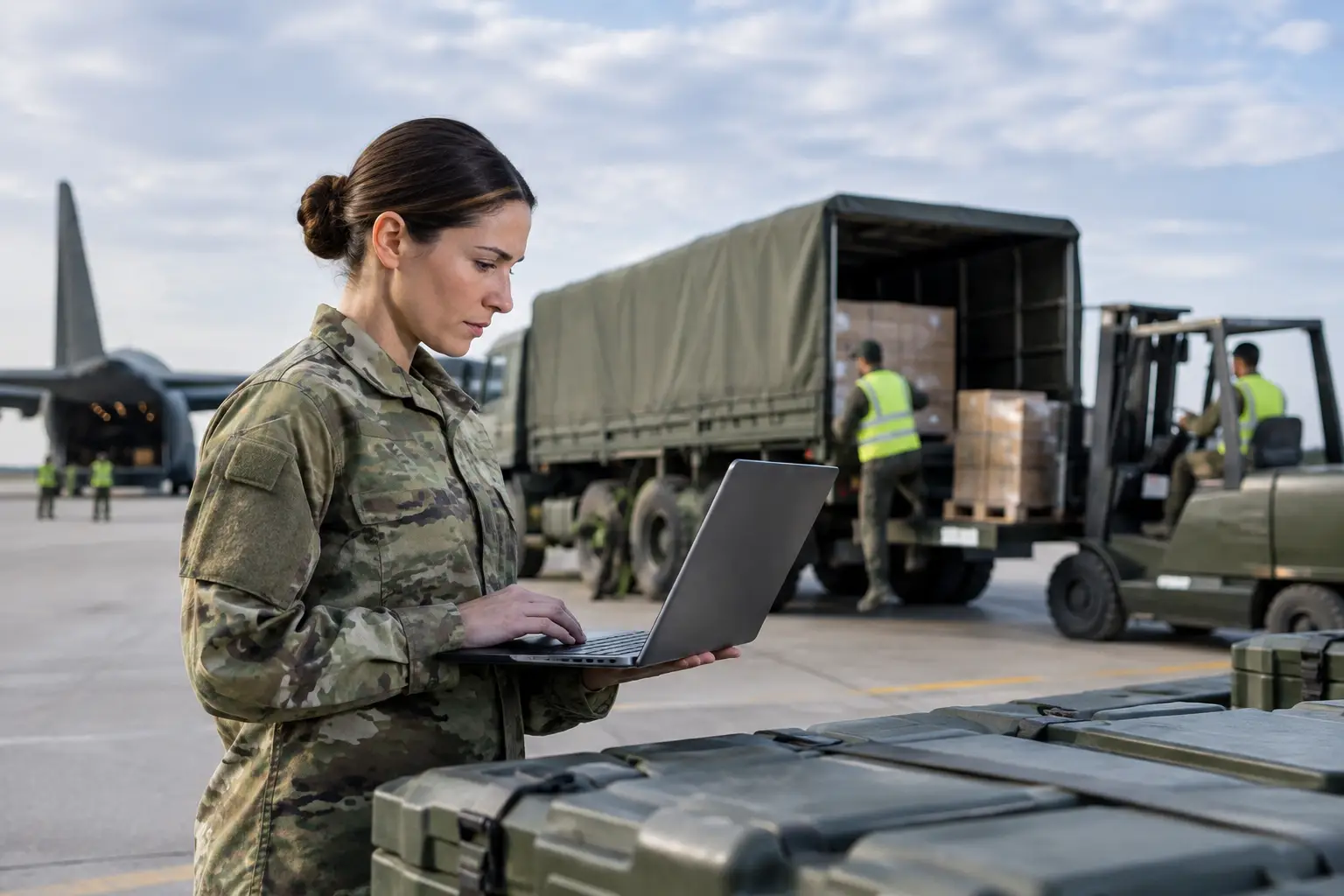
When a critical part, medical supply, repair component, or field-support load must move now, the issue is rarely just finding a truck. The real challenge is making a fast transport decision without losing control of cost, authorization, shipment status, dock capacity, documentation, or final invoice. Military emergency logistics software is built to bring those decisions into one governed workflow.
For organizations supporting defense-related operations, emergency freight is not an occasional inconvenience. It is a distinct operating mode. Contracted capacity may be unavailable, shipment priorities can change within minutes, and teams may need to coordinate facilities, carriers, suppliers, and finance teams across multiple locations. A process based on email threads, individual carrier portals, and spreadsheet updates creates delay precisely when response time matters most.
The right platform does not simply accelerate booking. It gives transportation teams a controlled way to source capacity, execute shipments, track exceptions, and validate spend when the normal plan is no longer enough.
Why Emergency Freight Requires a Different Operating Model
Planned freight is structured around recurring lanes, approved carriers, expected volumes, and established rates. Emergency freight operates under different conditions. The shipment may originate from an unfamiliar supplier, require a specialized equipment type, need immediate pickup, or need to be redirected before it reaches its original destination.
That does not mean organizations should abandon their transportation strategy every time an exception occurs. It means the strategy needs a defined exception path. Teams need to see contracted options first, then approved pre-negotiated alternatives, then live market capacity when required. Every option should be evaluated against service requirements, available capacity, cost, and operational constraints.
This is where fragmented workflows create avoidable pressure. Procurement may be calling carriers while operations updates a separate tracker. The shipping location may not know which carrier was selected. Finance may receive an invoice with accessorial charges that were never visible during dispatch. Each handoff adds time and weakens accountability.
Military emergency logistics software should connect those steps rather than treating them as separate tasks. The goal is not to eliminate judgment from a high-priority move. The goal is to give experienced logistics professionals the information and controls needed to make that judgment quickly.
What Military Emergency Logistics Software Must Control
A credible emergency logistics process starts with procurement flexibility. The platform should allow users to compare available capacity across contracted freight, pre-negotiated spot options, and approved live-bid sourcing within the same operating environment. This prevents urgent moves from becoming isolated transactions that sit outside procurement policy and cost visibility.
Speed matters, but speed without authorization creates downstream problems. Role-based workflows should clarify who can request, approve, award, modify, and close a high-priority shipment. The level of control depends on the organization. A local facility may need authority to dispatch immediately within defined limits, while exceptional spend or specialized moves may require central approval. The system should support both without forcing every load through the same approval path.
Execution control is equally important. Once a carrier is selected, the operating team needs one shipment record containing pickup and delivery details, required equipment, instructions, contacts, milestones, and changes. Carrier collaboration should happen against that record, not through disconnected messages that are difficult to audit later.
Visibility must be practical rather than decorative. A map alone does not resolve an exception. Teams need milestone status, estimated arrival updates, missed appointment alerts, proof of delivery, and a clear record of who acted when a disruption occurred. The best view is one that helps a transportation manager decide whether to wait, reroute, add capacity, reschedule a dock, or escalate.
Financial control closes the loop. Emergency moves often carry accessorials, detention, layover, or other charges driven by real operating conditions. Those charges should be reviewed against the shipment plan and supporting records before payment. Without integrated invoice validation, organizations can move freight quickly but lose visibility over the final cost of the decision.
Dock and Yard Capacity Cannot Be an Afterthought
An urgent shipment can still fail operationally if the receiving site has no available door, labor, staging space, or yard coordination. Transportation decisions and facility decisions need to work together.
For a multi-plant network, dock scheduling and yard status provide context that dispatch teams cannot get from a carrier update alone. If a delivery is arriving early, late, or with a different equipment type, the site needs time to adjust. A connected workflow helps the transport team see the consequence of a schedule change before it turns into congestion at the gate.
This is especially relevant when emergency freight competes with planned inbound and outbound activity. Priority cargo may need to move first, but the operation still needs a clear, documented plan for how that decision affects the rest of the facility schedule.
Build a Workflow for the Exception, Not Just the Average Load
The most effective implementations define emergency freight before the first crisis. That starts with shipment classifications. A team may distinguish between expedited production recovery, facility outage support, critical maintenance, and time-sensitive replenishment. Each category can have its own approval thresholds, preferred mode options, notification rules, and reporting requirements.
Next, define the sourcing sequence. A practical policy might require users to check contracted and pre-negotiated capacity before initiating an approved live bid. There will be moments when the market is the only viable option. The point is to make that decision visible and consistent, not to slow it down.
Carrier performance should also be measured in the context of emergency service. Standard on-time metrics remain useful, but they do not tell the full story. Teams should examine acceptance speed, pickup reliability, communication quality, tracking completeness, appointment performance, and invoice accuracy. These measures show which providers perform when operational stakes are high.
Finally, the workflow should capture the reason for the exception. Was the move triggered by a supplier delay, a production issue, a missed appointment, equipment failure, demand change, or a planning gap? That data is valuable. Over time, it helps logistics leaders separate unavoidable events from recurring process failures that can be addressed through better planning, carrier strategy, or inventory positioning.
Data Turns Urgent Freight Into a Management Decision
Emergency transportation is often treated as a cost of doing business. That view leaves value on the table. When urgent moves are captured in one system, leaders can analyze frequency, root cause, lane, location, carrier response, mode choice, and total validated spend.
The result is not a simplistic target to eliminate all expedited freight. Some urgent shipments are necessary and commercially justified. The more useful question is whether each move used the right capacity source, met the required service level, and followed an accountable process.
A transportation management platform should give operations, procurement, and finance a shared version of that answer. Operations needs current status and exception alerts. Procurement needs sourcing history and carrier performance. Finance needs approved shipment details and validated charges. Senior leadership needs a clear view of the operational and financial patterns behind high-priority freight.
That single operating view is particularly valuable across distributed plants, warehouses, suppliers, and delivery sites. It replaces the recurring search for the latest spreadsheet or the correct email chain with a live record of what was requested, awarded, executed, and paid.
Integration Determines Whether Control Holds Under Pressure
Emergency logistics software should not become another isolated tool. The platform needs to exchange relevant information with the systems that create demand and receive transport results. Depending on the operation, that may include ERP systems, warehouse systems, order platforms, business intelligence tools, carrier data feeds, and finance workflows.
Open APIs matter because every enterprise has a different operating model. But integration should be approached with discipline. Start with the data that directly affects dispatch and financial control: shipment orders, location details, product or equipment requirements, status events, proof of delivery, and invoice information. Expanding from a reliable core is usually more effective than trying to connect every system in the first phase.
Easy4Pro applies this principle through a unified procurement-to-payment workflow. Shippers can manage planned freight and urgent exceptions in the same environment, while keeping sourcing, execution, visibility, dock and yard coordination, carrier collaboration, invoice validation, and reporting connected.
Choose Control Without Adding Complexity
The best military emergency logistics software is not defined by the longest feature list. It is defined by whether a transportation team can act faster while retaining the controls that matter after the shipment is delivered.
Evaluate platforms against real exception scenarios. Ask how a user finds capacity when the primary carrier declines. Ask how dispatch communicates a changed appointment to the site. Ask how leaders see whether the move is progressing as planned. Ask how finance validates the final invoice against the work that was authorized.
A strong answer should follow the shipment from request through payment, with no manual reconstruction required. When high-priority freight is managed as a connected process rather than a collection of urgent messages, teams can respond with the speed the mission requires and the commercial discipline the operation depends on.